The blog had been quiet a long time before I archived it. Its last sign of life was a pair of dutiful version bumps to keep the Haskell build from falling over, one in 2018 and one in 2020. After that, nothing. It had been busy enough once, though busy with building more than writing. It ran on Nikola, then Hakyll, gathering up a Cloud Build pipeline, a Nix file, and a couple of theme changes along the way. In all twelve years, that machinery had carried just one new post, How I Read. So when I went through my GitHub, closing out projects I no longer worked on, I came to this one and barely paused. It was cruft like the rest, and it went without ceremony. I didn’t expect to open it again.
In January I started building genshin.dungeon.studio from scratch, pair-programming with an agent, and the energy came back almost at once. It was the kind of total absorption I hadn’t felt since university, when a whole Saturday on World of Warcraft flipped into a whole Sunday on programming, both days deep in flow. And it was fun again, the kind Martin Fowler calls a great lost joy of software development. I was building at a pace I hadn’t touched in years, ideas and workflows stacking up faster than I could use them.
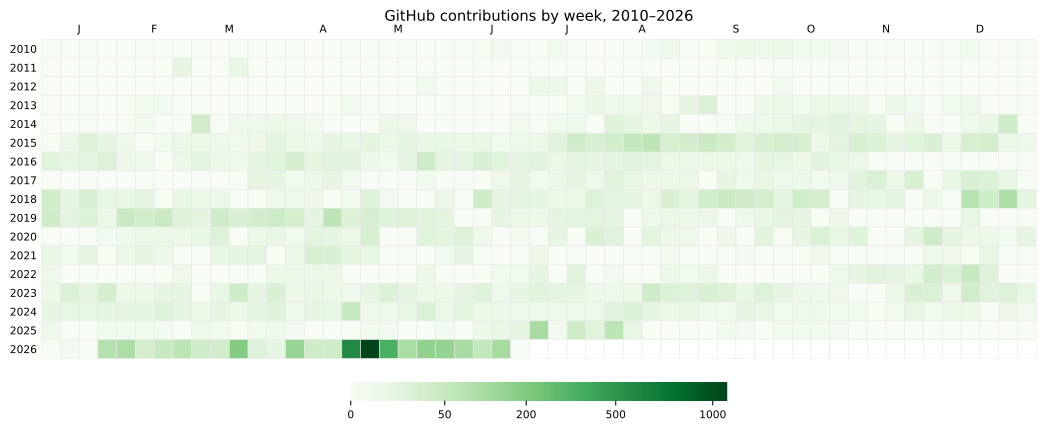
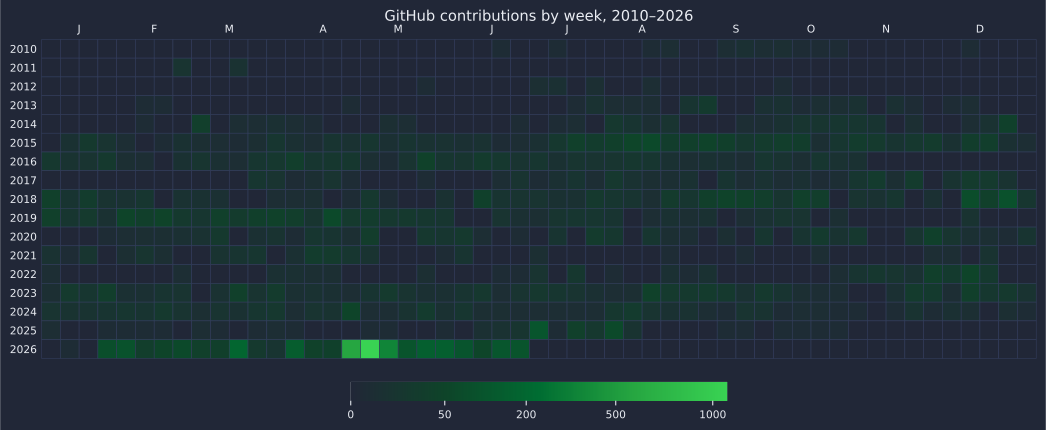
My GitHub contributions by week, 2010–2026. The colour runs on a square-root scale, so the steady years stay visible next to 2026’s spike.
Around then I was building a harness for my whole setup, the agents, dotfiles, and skills wired into one loop that fed itself. I’d built it for reuse on purpose. Each piece was written once and meant to drop unchanged into the next thing. What I hadn’t expected was how much it paid off. The reused parts compounded, each carrying into the next. Seeing that is what turned me toward sharing. Parts that did this much for me weren’t only mine to keep. Someone else could lift one out, or someone had already built a better version I’d never see unless I shared mine.
I wasn’t trying to build an audience, only to reach the few people who’d find a useful part and the few who’d show me a better one. The usual road there is social media, which has never taken for me. I’ve never been sure how to start or how to keep it up. A blog asked less. It was somewhere to set the work down and let people find it. So in May I reopened the repository, tore out the Haskell stack, and stood up AstroPaper in one pull request.
The same energy spread past the blog into everything else. I’m writing small Haskell libraries again, working out a shared shape to build them on. My machine’s setup lives in alunduil-chezmoi now, with the rest of my hosts to follow. I’m improving zfs-replicate, which I no longer run myself, but the NixOS community still packages. I’m standing up alunduil-infrastructure as the code behind my whole home network and personal services. I build like this whenever a passion takes hold. After years of a near-empty calendar I was at it again, well before I was writing.
And every piece of it wants writing up. There are notes on living in git worktrees day to day, the homelab set down as a system instead of a pile of services, a reckoning of what the AI-coding bills actually come to, and a backlog of book and game reviews I keep meaning to clear. There are more posts queued now than I’ve published in two decades.
None of it came from a better tool. AstroPaper is just another static-site generator—widely used, widely forked, dozens of hands on it—and out of the box it fits no one in particular. What fit it to my hand was the scaffolding I built around it: a deploy that runs on every push, the DNS kept as code. That shaping is the work that makes a generic thing yours, what Fowler means by crafting your tools to fit your metaphorical hand.
Yet I’d done it all before. The Haskell blog had its own Cloud Build pipeline, its own Nix file, its own Docker image—the same hand-shaping, tended for years. I built the machine twice, and the first time it published nothing. The tool never filled the page. Neither did the scaffolding. The drive did.
There’s a catch, and I see it. This post didn’t come straight from me. It came through a machine I built to write it: an outline step, a draft step, a reading-level check, an agent at my shoulder. I sat down to write one post and built the pipeline first. Building it was a pleasure; writing the post it existed to produce was the slow, grinding work. And the pleasure is the problem: I love making systems for their own sake, and that love doesn’t know where to stop. One improvement opens onto the next, and before long I’m polishing the machine instead of feeding it.
What’s different now is that I see it happening and turn back. The machine points at the work getting out, not at being a finer machine. The urge to fiddle hasn’t gone quiet; I just keep aiming it at the page. The post is out, and the queue behind it is real.